
Installation instructions
Install the extension via the extension area.
OpenAI API key
- Go to https://platform.openai.com/.
- Log in.
- Create a new project.
- Go to your profile and go to the "API keys" section https://platform.openai.com/settings/organization/api-keys.
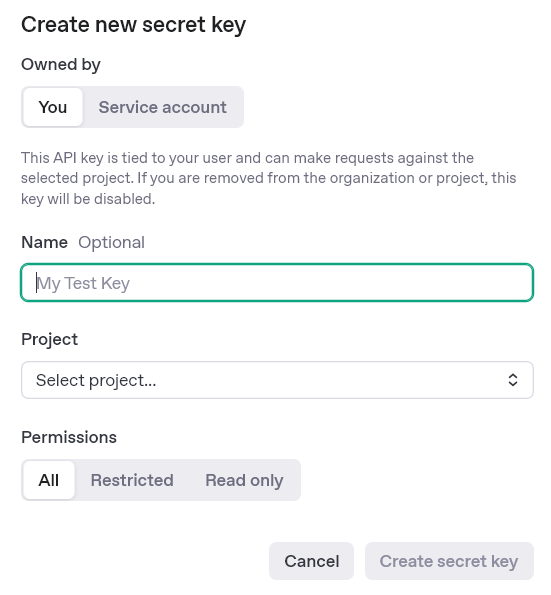
- Create a new API key via "Create new secret key".
- Top up credit so that the OpenAI API works. https://platform.openai.com/settings/organization/billing/overview
- Optional: We recommend that a usage limit is set so that no unnecessary costs are incurred in the event of an error https://platform.openai.com/settings/organization/limits
Setting up the extension in Shopware
API credentials
- Enter the API key, this should start with "sk-proj".
- Select your desired AI model.
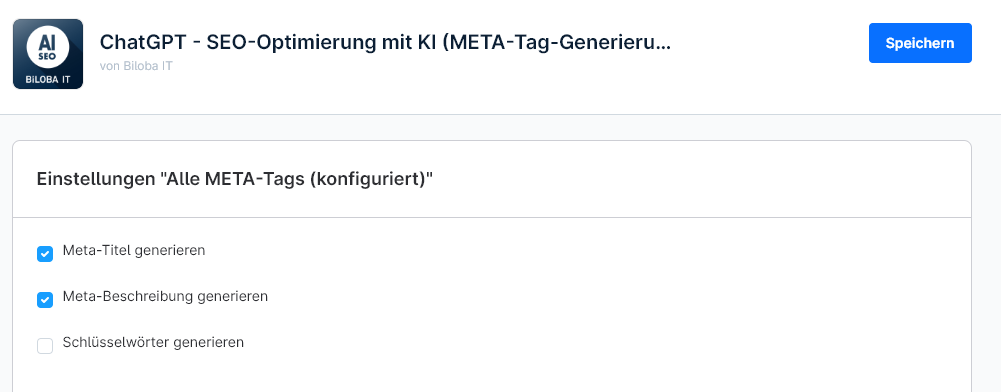
Settings "All META tags product / category (configured)"
Settings for the creation of SEO data in mass processing. These settings are only for mass processing or for the "All META tags (configured)" button in single mode.
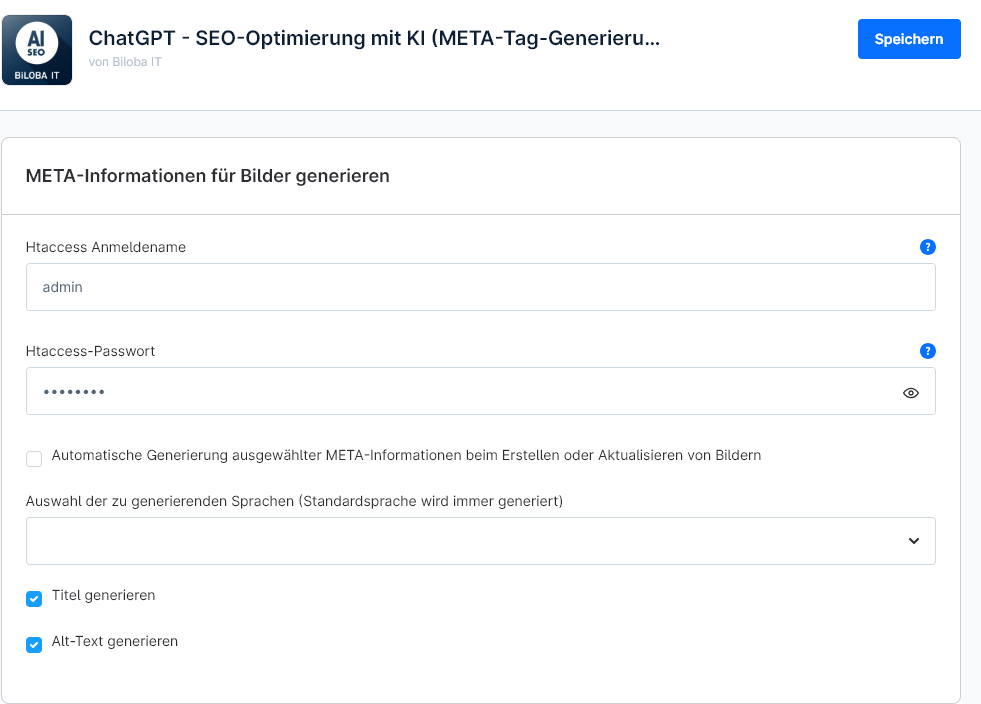
Creating META information for images
- Automatic generation of selected META information when creating or updating images: this setting allows the META information for images to be inserted directly when uploading or updating. This works automatically, please check your OpenAI limits.
- This option works NOT with the product context. In order for meta data to be generated with the product context, the article must first be saved with the desired image. This is necessary for the assignment.
- Selection of languages to be generated (default language is always generated): a list of the languages in which the META information is generated.
- Checkboxes which information is processed in mass processing and automated creation.
- If you have an active Htaccess for your shop, you must enter these login details here so that the image META information can be created. This is necessary because the images are analysed by OpenAI and access is required.
General settings
- Keywords: Global keywords that are to be taken into account by the AI during META generation.
- Polite form: Which form is used when creating texts.
- The temperature indicates how random the AI's answers are. Further information here: https://platform.openai.com/docs/api-reference/assistants/modifyAssistant#assistants-modifyassistant-temperature
- Top P is an alternative sampling method similar to temperature. Further information here: https://platform.openai.com/docs/api-reference/assistants/modifyAssistant#assistants-modifyassistant-top_p
AI processing single entity
Products SEO data
- Go to Catalogues -> Products and select your desired product.
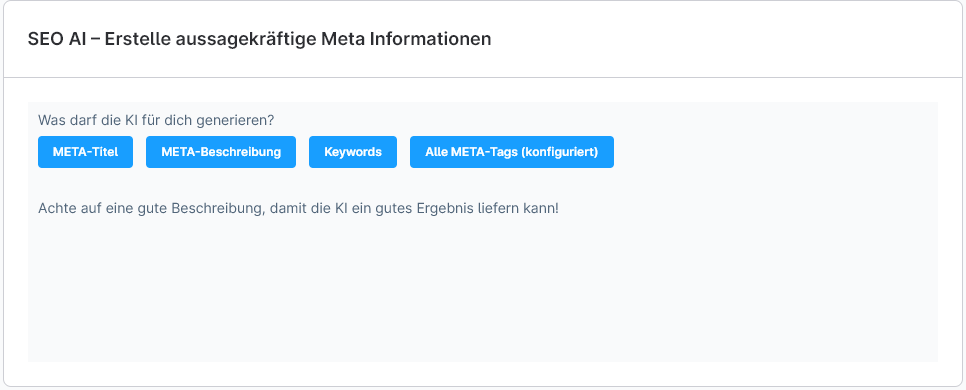
- Meta title, meta description and keywords can be created in the SEO area.
- Use the corresponding button to create your desired SEO data or all three.
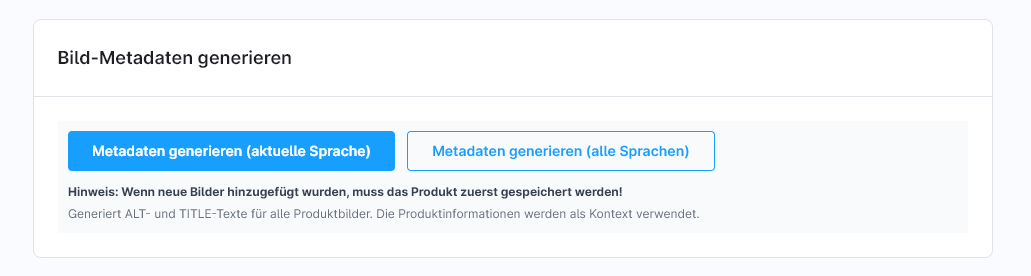
Products Images Meta Data
- Go to Catalogues->Products and select your desired product.
- Go to the pictures section.
- Meta data can be generated here for images that have already been saved.
- Please note that meta data is only generated if the article has been saved with the desired images.
Category SEO data
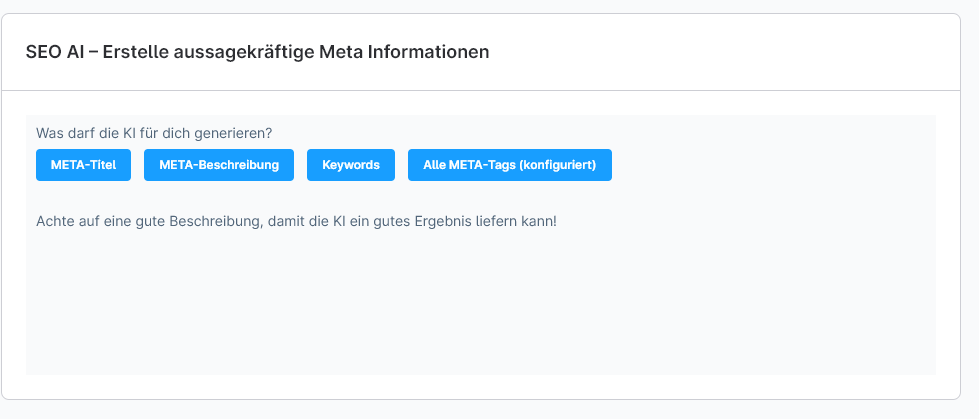
- Go to Catalogues -> Categories and select your desired category.
- Meta title, meta description and keywords can be created in the SEO area.
- Use the corresponding button to create your desired SEO data or all three.
Bulk text editing
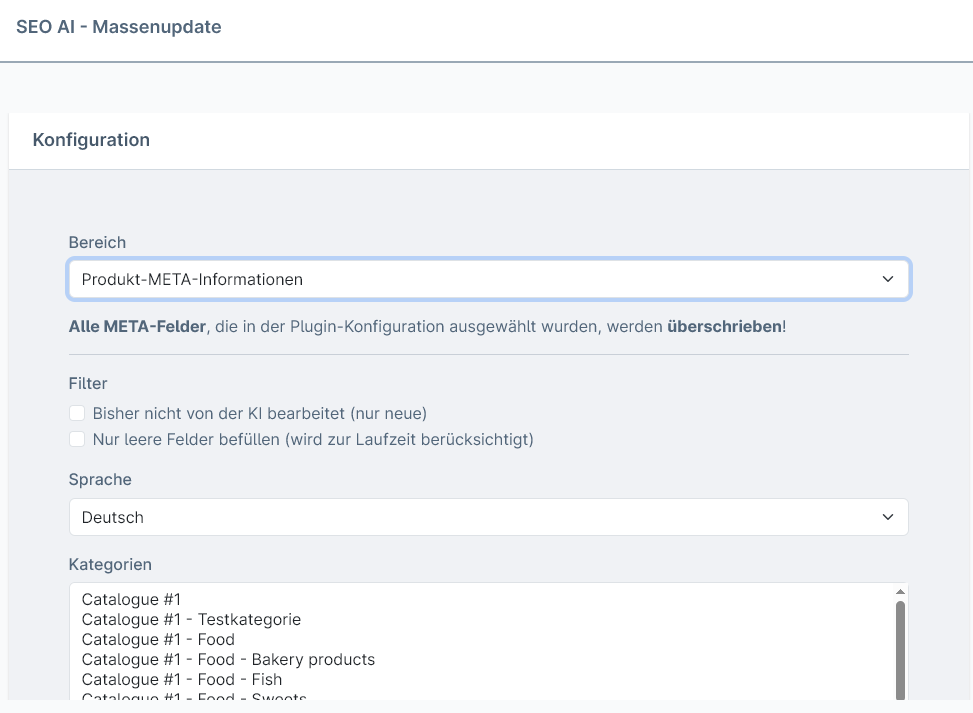
- Go to Catalogues -> SEO AI - Mass update.
- The desired area to be edited can be selected in "Area".
- Product META information
- Image alt and title text
- Individual settings are available for the various areas
- Filter specifies whether something should be taken into account when selecting the areas to be processed, such as only processing entities that have not yet been processed by the AI
- Languages specifies which language is to be edited.
- Categories offers a category selection. This is used to narrow down the entities to be edited. Select all categories with Shift+click to edit all entities.
- The entities found, which are processed, are listed below.
- In the "Currently running bulk jobs" area, it is displayed whether a job is currently running
Prompting
Overview
The Prompting module allows you to customise and modify AI text generation. It is possible to extend or replace the default prompts. A basic understanding of prompting is required, so this module is only recommended for „experts“.
Access to the prompting module
The prompting module can be accessed in two ways:
- About the settings: Navigate to Settings → Plugins → SEO AI Prompts.
- About the mass update: In the mass update module, you will find a „Configure prompts“ link directly in the configuration view.
Available areas
The following areas are available to you in this app:
- Product meta title: SEO-optimised product titles
- Product meta description: SEO descriptions for products
- Product meta keywords: Relevant keywords for products
- Category metadata: SEO data for categories
- Media metadata: Alt texts and titles for images, product context can be set here. Please note.
Configuration options per area
1. Additional prompt (optional)
- Special instructions can be added here, which are sent to the AI in addition to the standard system prompt.
2. Available variables
- The available variables are displayed for each area.
- Variables can be clicked directly to insert them into the additional prompt.
- The variables are automatically inserted at the cursor position in the text.
- Available variables depending on the area:
##targetLanguage##– Target language##productName##– Product name##productText##– Product description##productNumber##– Item number/MPN##productManufacturerName##– Manufacturer name##productManufacturerDescription##– Manufacturer's description##categoryName##– Category name##categoryText##– Category description##lengthFrom##/##lengthTo##– Text length specifications##keywords_amount##– Number of keywords
3. AI model selection
- The OpenAI model can be selected for text generation.
- Different models have different strengths and costs:
- GPT-5 Mini: Fast and cost-effective, ideal for large volumes
- GPT-5: Balanced performance and quality
- GPT-5 Nano: Compact model for simple tasks
- GPT-4.1 series: Older models, still available
4. System prompt settings
- The standard system prompt contains the basic instructions for the AI.
- Disable default system prompt„ option: can be used if you want to take complete control. Please only activate if you are familiar with prompting.
- The current system prompt is displayed for transparency.
Important information for prompting
Caution when adjusting prompts:
- Prompts should only be adapted if you are familiar with prompting.
- All adjustments are made at your own risk.
- Test changes first in single mode or in mass editing with a few elements.
- The prompt that was actually sent can be checked in the logging module in the detailed view.
Best practices for your own prompts
- Be specific: The more precise your instructions, the better the result.
- Use variables: Use the available variables for dynamic content.
- Test step by step: Start with small changes and test the results.
- Examples are helpful: Give the AI examples of the desired style.
- Note the length specifications: Use the length variables for precise text lengths.
Examples of additional prompts
For product descriptions:
Write in an enthusiastic tone and use bullet points for the most important features. Start with a compelling introductory sentence that addresses the main problem that ##productName## solves.For meta titles:
Always include the manufacturer name ##productManufacturerName## at the beginning of the title. Use action-oriented words such as "Buy", "Order" or "Discover".For category descriptions:
Structure the description in 3 paragraphs: 1. Introduction to the category 2. Main advantages of the products in this category 3. Call to action to browseLogging and control
Once the text has been generated, it can be checked in the logging module:
- Which prompt was actually sent to the AI.
- How the variables were replaced.
- What result was generated.
This helps you to continuously optimise your prompts.
Tips for troubleshooting
- Texts that are too short/long: Adjust the length specifications in the plugin configuration.
- Wrong tone: Add specific sound instructions in the additional prompt.
- Missing information: Ensure that all required product data is maintained.
- Inconsistent results: Use more specific instructions or change the model.
SEO AI - Log
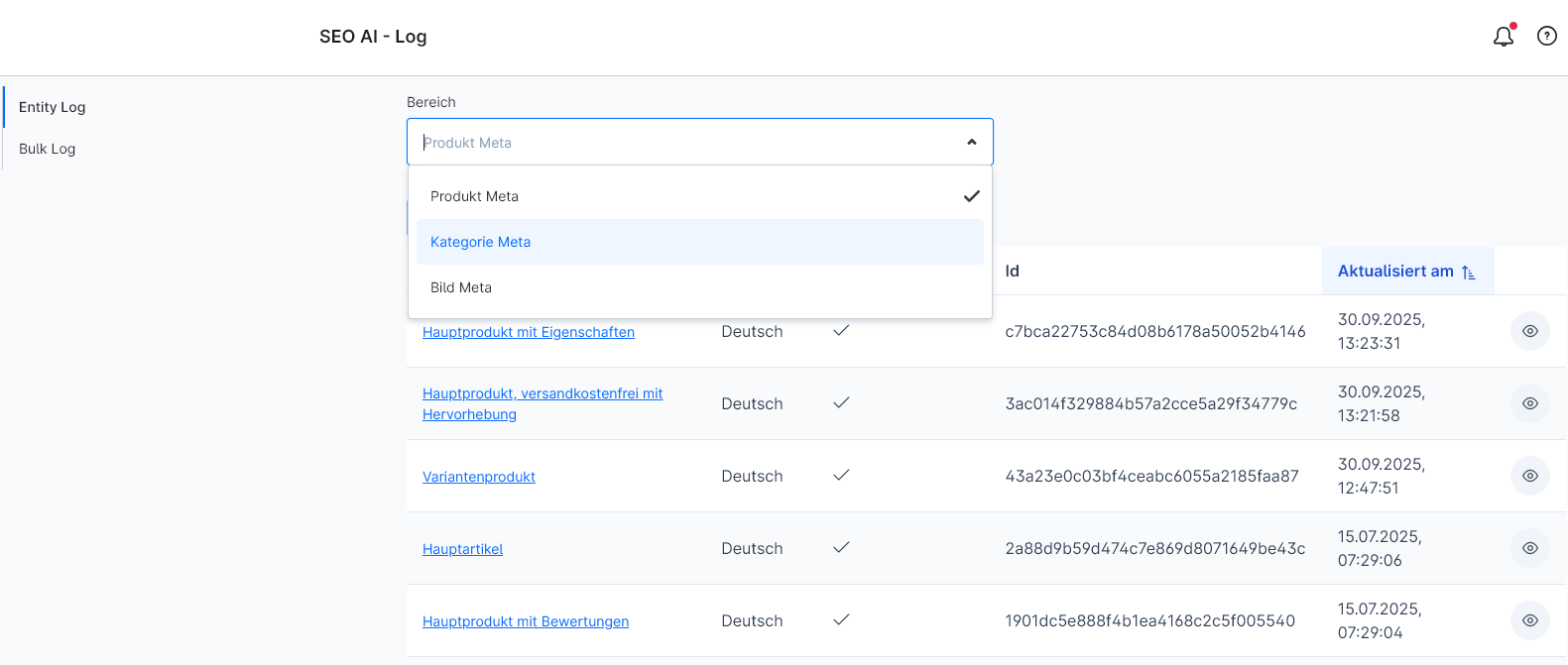
The SEO AI log records every job that has run for the corresponding areas. If a job does not run, the log is the first point of contact.
Go to Catalogues -> SEO AI - Log
Entity Log
The individual entities that are processed by the AI are entered here and sorted by area.
Bulk Log
The bulk log jobs are entered here.
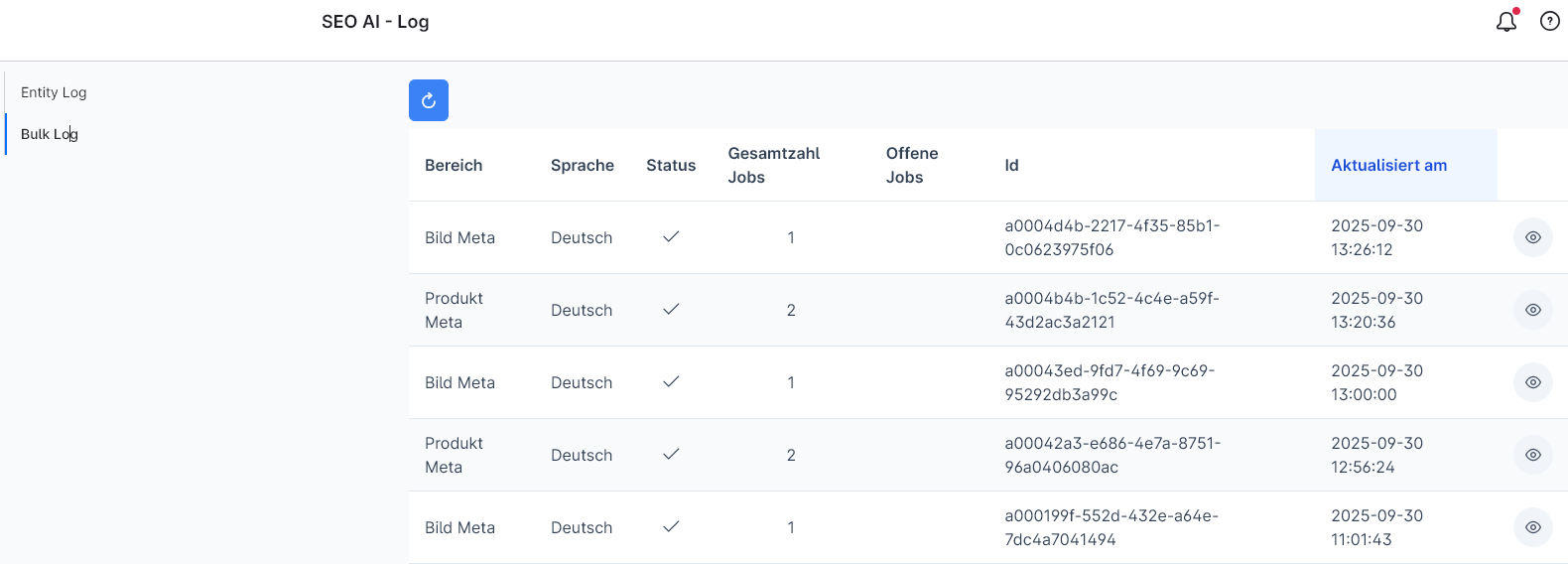
Common errors - entries in the log:
- error_no_credits: indicates that no credit is stored in the OpenAI account.
MCP server administration
What are MCP servers?
MCP servers (Model Context Protocol) are external services that give the AI additional capabilities. During text generation, the AI can contact these servers to retrieve real-time data - for example, current SEO keywords, search volumes or competition analyses.
Add server
To add a new MCP server:
- Click on „Add server“
- Enter a name for the server (e.g. „SEO Keywords“)
- Select the server type from the list
- Enter the required access data (API key, URL, etc.)
- Save the configuration
Test server
After saving, you can test the connection:
- Click on the test icon next to the server
- The server is contacted and the available tools are retrieved
- If the connection is successful, you will see a confirmation
Link server with prompts
So that an MCP server is used for text generation:
- Go to the prompt settings
- Select the desired prompt type (e.g. „Product description“)
- In the „MCP server“ section, select the servers to be used
- Save the settings
The AI then automatically uses the linked servers during generation.
Troubleshooting
Server connection failed:
- Check the access data (API key, URL)
- Ensure that the server is accessible
- Check whether your API quota has not yet been exhausted
No tools available:
- The MCP server may not respond correctly
- Contact the provider of the MCP server
Generation takes longer:
- MCP server requests can extend the generation time
- This is normal as additional data is retrieved
In-app purchases
What is Prompts Plus?
Prompts Plus is an optional upgrade that unlocks advanced features for your AI text generation. The most important feature is the MCP server integration, which allows you to integrate external data sources.
Included functions
- MCP server integrationConnect external tools and data sources
- Advanced prompt optionsLink server with specific prompts
- Real-time data queriesAI accesses current data during generation
Purchase and activation
- The purchase is made directly via the Shopware Store
- The feature is activated automatically after purchase
- You can see the status in the „In-App Purchases“ overview in the log area
Subscription information
- Prompts Plus is a monthly subscription
- You can see the remaining runtime in the „In-App Purchases“ overview
- The subscription is automatically renewed via the Shopware Store
System requirements
- Shopware version 6.6.9.0 or higher
- Active Internet connection for MCP server communication
FAQs
AI Shop Assistant: General questions
Open AI: General questions
The OpenAI account can be accessed via this link: https://platform.openai.com/ .
Here you will find the management of the credit, limitation and the API keys, which are necessary for the extension!
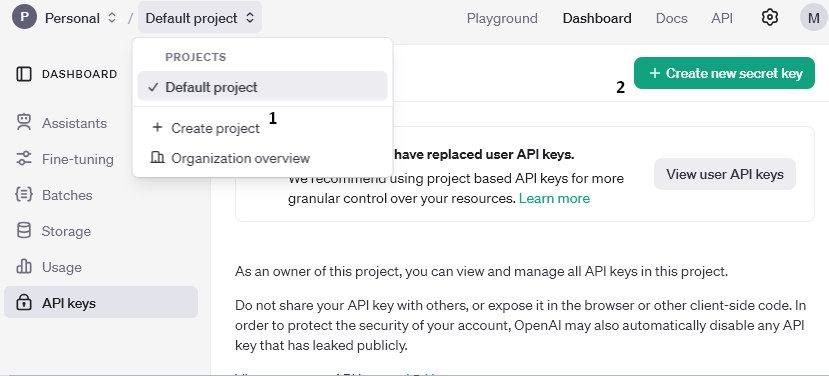
- A new project must be created first.
- A new API key can be created here and assigned to a project.
This key can be entered in the configuration of the extension.
Credits are required for the OpenAI API to function properly. As with other services, this is a "prepaid" method. You top up the credits and these are automatically "spent" as soon as the extension is used and a request is sent.
To top up credits with OpenAI, a payment method must be set up via your own profile.
The payment methods can be found under: Organisation -> Billing. A new payment method can be added here via "add payment details". If this is done, credits will also be topped up.
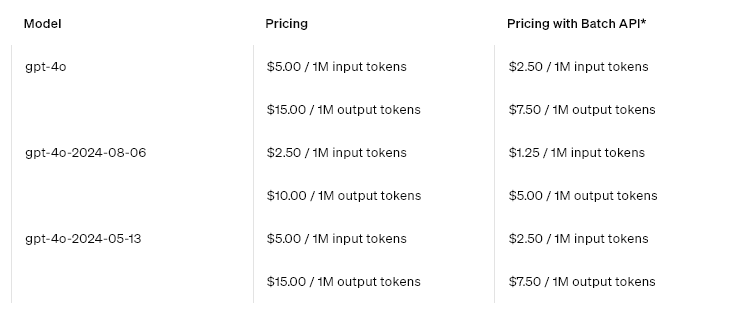
Credits are billed in dollars. OpenAI uses "tokens" - one token corresponds to approx. 4 characters.
Overview table from OpenAI https://openai.com/api/pricing/:
If, for example, only a certain budget of credits per month is available or for protection, limits can be set.
Monthly limits can be set via the profile: Organisation -> Limits, as well as an e-mail notification as soon as a certain amount is reached.
OpenAI provides usage in different "tiers". Initially, every user is in the "Free" tier, which severely restricts the use of the AI models to a few requests per minute. As soon as $5 has been paid for, these restrictions are greatly reduced and the extension can be used more efficiently.
Further information on the limitations can be obtained directly from OpenAI: https://platform.openai.com/docs/guides/rate-limits/usage-tiers?context=tier-free
Which current "tier" has been reached can be seen in the account here: https://platform.openai.com/settings/organization/limits
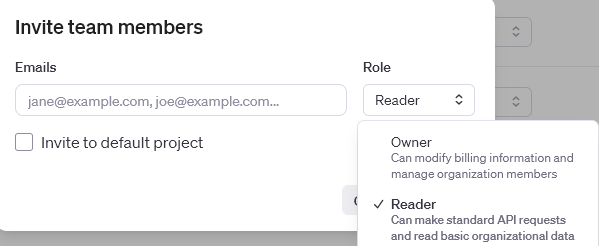
If there is interest in having someone else check settings and limits, members can be invited to join the organisation.
You can find the area here: https://platform.openai.com/settings/organization/members
A new person can be added here via "invite". There are two role options to choose from, here you can specify whether the new member can only view certain data or whether they can contribute to the organisation. As the first option is quite limited and certain tasks cannot be assigned, it is advisable to assign the "Owner" option.
We recommend that you always use the latest model.
For cost reasons, the predecessor model can also be used.
No, the plugin works completely without Prompts Plus. The MCP server integration is an optional upgrade for advanced use cases.
The plugin supports all MCP servers that comply with the Model Context Protocol standard. Common examples are SEO tools, keyword research services and analysis platforms.
Generation may take a little longer as additional data is retrieved from external servers. The improved text quality due to the real-time data usually compensates for this.
Yes, relevant information (e.g. product name, keywords) is sent to the configured MCP servers for the query. Make sure you only use trustworthy servers.
Note: Biloba IT accepts no responsibility for data transmitted to external servers.
Yes, you can integrate any MCP-compatible server. Simply enter the corresponding access data in the server administration.
Text generation also works without an MCP server. If a server is not available, the text is generated without the additional data.
No solution found?
Describe your problem to us - we'll take a look at it and get back to you as soon as possible.
 German
  English